














By Merryn Spence
I've spent several years mentoring people who want to learn how to facilitate psychedelic experiences and hold space in psychedelic contexts. Part of that time was spent teaching within formal training programs, working with students who enter this field with earnest hearts and a sincere desire to help. No matter the cohort, the same question inevitably arises, often quietly, sometimes with visible fear:
How do I practice psychedelic care safely without harming anyone while I'm still learning?
It's an honest question. And it points directly to one of the deepest structural gaps in psychedelic education today. It also gestures toward a larger cultural rupture, our disconnection from elders, apprenticeship, and long-term mentorship, though that is a related but separate story.
Even in programs that cost well over ten thousand dollars, opportunities for supervised, embodied practice are limited. Teaching hours are finite. Faculty and teaching assistants are stretched thin. Many psychedelic facilitator training programs and courses rely on short roleplays, peer exchanges, or imagined scenarios to prepare students for moments that are anything but imagined. Sometimes, access to an actual supply of psychedelic substances is non-existent. Some programs require in-person evaluation as part of their professional preparation; others do not.
I won't attempt to unpack a full list of ethical considerations around that here, though I will say this: it is unsettling that certificates are sometimes granted without ever witnessing how someone actually shows up in the presence of another human being in an altered state, particularly in the context of psychedelic-assisted therapy for mental health conditions.
A further, sobering reality is that many people entering any given program or certification process have not themselves worked with psychedelics. That fact alone deserves its own reckoning.
Students finish these polished, costly programs with knowledge, words, and ideas. But they often lack enough real practice to feel steady when someone panics, disconnects, grieves, or is scared in front of them. They understand the stakes. They know that despite academic rigor their inexperience, even when well-intentioned, can cause harm.
I want to share a personal story, not to sensationalize, but to illustrate what is truly at stake when people are asked to hold others without adequate preparation or education for spaceholding.
What I Learned From My Own Experience
When I was a young adult, I took LSD at a large outdoor festival. The environment was already overwhelming for me: flashing lights, a dense sea of bodies, sound and rhythm bleeding into everything. Speaking of, shortly after dosing, I started my period. The cramps arrived without mercy. At that time in my life, they were often unbearable, intense enough to require lying curled up on the floor, nauseated, unable to function. I could feel myself heading in that direction.
Time began to fold in on itself. My thoughts looped. My chest tightened. Fear and dread crept in, sharp and convincing.
A stranger noticed my distress and guided me to a tent designated as a safe space, something akin to a Sanctuary or Zendo Project tent, though clearly a tad more under-resourced. I remember the relief of believing I had arrived somewhere safe.
Inside, it was chaotic. Mats and art supplies scattered across the floor. Too many people. Too few volunteers. Eventually, a young man sat down next to me. He smiled, but his presence felt thin, as if part of him was already elsewhere.
I tried to explain what was happening in my body. The panic. The looping thoughts. The fear that I had taken too much. The pain, which was becoming excruciating. He nodded, but didn't quite meet me. He told me I was fine. Suggested I focus on the music outside. When that didn't help, he pivoted to talking about his own LSD experiences, how profound his last journey had been, how excited he was for the headliner the next night.
I remember feeling myself shrink as he spoke. Confused. Ashamed, as if I were failing some unspoken test of what a psychedelic experience should look like. I stopped sharing because it was clear my fear made him uncomfortable.
He wasn't cruel. He wasn't malicious. He simply didn't know how to hold the moment he had stepped into, even though he was tasked with doing exactly that.
When I asked if there was anything for pain, he offered me his prescribed tramadol. At the peak of my experience, I didn't recognize the name or have the capacity to ask informed questions. I took it.
Within minutes, my body began to unravel. I was sweating, shaking. My heart rhythm felt erratic. Dissociation set in hard and fast. Time disappeared. My body wanted to vomit, but something inside me seemed to resist it. I entered a long, haunting loop that lasted hours.
Later, I learned that I had been screaming. I have no memory of that. Eventually, I was taken to the medic tent. Thankfully, I got through the journey without lasting physical damage.
For those of you who don't know, tramadol is one of the few pharmaceuticals that is considered contraindicated for LSD. Not fatal by any means, but they certainly don't have synergy. While the lack of pharmacological knowledge was glaring, what stayed with me was something quieter and more enduring. The realization that the person sitting with me had been entrusted with care. I later found out he was not just a volunteer, but a lead trainer in that space and an underground psychedelic facilitator.
His lack of training in terms of care and education caused harm for me at that moment. Minimal in the grand scheme, perhaps, but harm nonetheless. I know I'm not alone in experiencing this kind of harm.
That experience took years to integrate, and even longer to name clearly for what it was. It fundamentally shaped how seriously I take preparation, harm reduction, and humility in this field. Whether someone is a festival volunteer, a therapist, a facilitator, a medic, or a guide, the responsibility for supervised sessions is the same. We are entering intimate, destabilized terrain with other people's nervous systems, histories, and bodies.
In my work as an educator, I see how deeply students want to avoid becoming that person. They ask nuanced questions. How do I respond when what is intended as reassurance ends up minimizing the experience? When is silence supportive versus abandoning? What do I do if my own nervous system starts to hijack the space?
They also ask practical questions. About emotional healing and post-session integration. About safety protocols and contraindications. About emergencies. About scope of practice and therapeutic outcomes. When to escalate. How to escalate. When not to.
I remember vividly the first time a stranger alluded to wanting to die while I was holding space for them on a mushroom journey. An internal alarm went off in my body. A wave of heat crept up my spine, not the mystical kind. I knew I might need to escalate to the medic team if those thoughts were active.
I froze. I didn't know what to say. So I said nothing for several moments. Then, all I could manage was, "Are you open to sharing more about that feeling?"
Thankfully, I had taken suicide prevention training years earlier, though up until that moment my practice had been almost entirely roleplay. There's only so far a volunteer actor is willing to take a simulated crisis.
I listened. I grounded myself. I validated what they shared and their existence. I thanked them for trusting me with something so tender. Then I asked, gently and clearly, "Are you still thinking about wanting to die right now?"
After some reflection, they shared that this was a thought they hadn't had in months. The mushrooms were inviting them to revisit a past desire for death from a new vantage point. We both felt a sense of relief.
Without training and a professional foundation, that moment could have easily been fumbled. Ignoring thoughts of suicide is dangerous. Escalating without assessing current risk can also create chaos and rupture. Holding these complexities requires practice and can benefit from practical experience.
In ceremony, what do you do when someone is yelling, "I'm dying!"?
How do you respond when someone in a sanctuary tent alludes to wanting to die? When someone is crying uncontrollably? When someone dissociates? When someone tells you the most traumatic story you've ever heard? When someone projects onto you that you are their abusive parent?
These are not edge cases. These are the realities of this work.
This is where simulation as practice begins to matter.
Lucy, a new simulation tool created by Fireside Project, is not a replacement for human care. It is a simulated client, designed to help people practice their space holding skills and knowledge before they ever sit with a real human being. She allows first-timers to work through jitters, hesitations, misattunements, and repair in a space where no one is harmed in the process.
This tool is not just for facilitators or those offering psychedelic therapy. It can be useful for medics and mental health providers unfamiliar with psychedelics. For peer support volunteers and community organizations. Even for law enforcement officers who may encounter people under the influence. Anyone who might find themselves responsible for another human in an altered state can benefit from practicing how to be a steady, non-escalating presence. Knowing when to nod and affirm presence. Knowing when to ask, "Are you open to sharing more?" Knowing your scope. Knowing when and how to escalate. These are skills. They are learned through repetition.
The work behind Lucy is grounded in serious research. Félix Schoeller, the neuroscientist behind the system, studies emotional resonance, empathy, and attunement. His work examines how subtle cues like tone, pacing, and affect shape felt sense of safety, and how technology can be designed to reflect those dynamics rather than flatten them. I highly recommend exploring his work further.
This is not about automation or replacing humans, and especially not about replacing relating and relationships. It is about helping humans become safer. It's also a reminder that not everyone is meant to be a facilitator in these times, and that's okay.
I want to be honest about my ambivalence. Every instinct in me longs for closed-loop systems, ancestral technologies, elders, and land-based ways of knowing. I am deeply wary of AI in general. The environmental impact alone is disturbing. The water consumption of data centers. The false information caused by hallucinations. The documented cases of ChatGPT responding to suicidal young people with not just dangerous but fatal advice. The flood of empty content across socials created for "optimized" engagement rather than care. I understand the anger and aversion and I share much of it.
But technology is not going away. The question is not whether it exists, but how it is used, and whether it is held with accountability.
At Fireside, the intention is to model an ethical, transparent approach to technology in mental health care and peer support education. Conversations are anonymized in real time. Personal data is protected and never sold or exported. The goal is not extraction, but learning. Not scaling, but access.
Lucy is not about replacing human connection. It is about practice, humility, and harm reduction.
The device you may be reading this on already tracks your attention in microscopic detail. What you linger on. What you save. What you scroll past and return to. Against that backdrop, it matters when technology is built with restraint, consent, and clear ethical boundaries.
Respect for different cultures is very important here. Psychedelic work intersects with lineage, ritual, power, identity, and history. Practitioners must learn not only how to respond to distress, but how to do so without imposing their own frameworks onto someone else's experience. Simulation can surface unconscious habits and biases, and offer opportunities to practice repair after rupture.
Simulation tools are not a panacea. They will not eliminate risk. They are one piece of a complex ecosystem. But if a simulated client helps even one practitioner learn to stay present instead of deflecting, to listen instead of self-soothing, to meet fear with steadiness rather than discomfort, then it belongs in the conversation.
We owe it to those seeking care, and to those learning how to offer it, to engage tools that reduce harm rather than pretending the gaps do not exist.
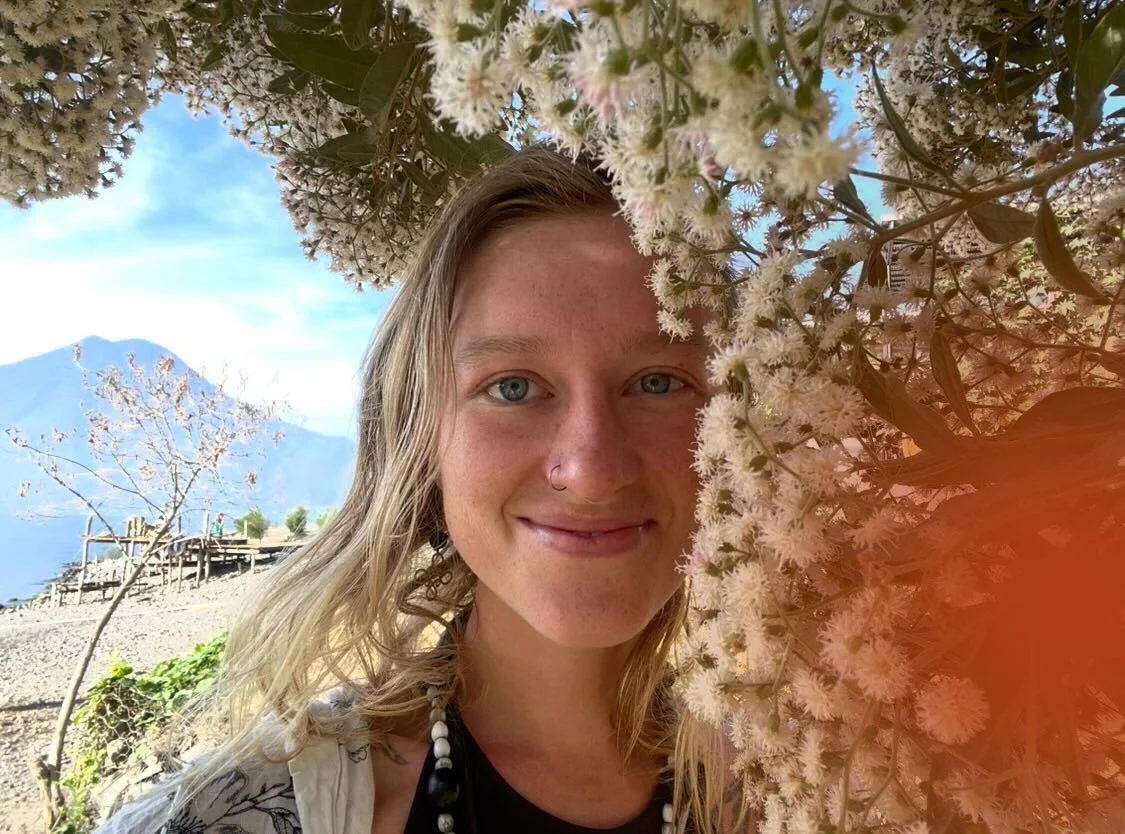
Merryn (she/they) loves expanding the mycelial web of human and more-than-human connection. They deeply enjoyed volunteering on the line for a year. Their journey in this field has taken them from the Amazon jungle learning with curanderos and pajés, to the mountains of Eastern Africa studying with traditional healers, and back home to PA to connect with the medicine of this region. She co-founded Three Rivers Psychedelic Society (TRiPS) and runs a small business called Entheogration. Merryn also serves on the board of Students for Sensible Drug Policy, where she coordinates the Drug Education Program. Part-time, she's pursuing an MSc at the University of Exeter focused on psychedelic research.